How Much Should You Really Save for Retirement?

Did you know?

Six out of ten Australians consider having a comfortable time in retirement a personal problem, while about nine out of ten consider it a national problem, according to ABC’s Australia Talks National Survey 2021.

Retirement planning can be a daunting task, especially when it comes to making the right financial decisions that will have a positive impact on your financial future.

In particular, it’s important to ensure you have enough retirement funds to live comfortably after your hard-working years and without the burden of your nest egg running out.

The age pension combined with your superannuation may be the main source of income for most retirees in Australia, however, without additional savings, this may not be enough to fund your retirement goals. By having a financial plan, you can ensure you are on target with your retirement savings to achieve your ideal retirement.

If retiring early is something you are wanting, then it’s crucial to plan ahead for your retirement and ensure your savings are on track to meet that goal.

Early retirement may seem unachievable to some, however with the right financial guidance and strategies in place, it may be possible.

What is the Standard Retirement Age in Australia?

What is the Preservation Age in Australia?

According to the latest Retirement and Intentions, Australia report released by the ABS in 2020, the average retirement age is 55.4 years, yet most Australians intend to retire at age 65.5 years. Australia has no definitive retirement age, however, to be eligible to access your super you must reach your preservation age. 

Your preservation age depends on the year you were born, but if you are currently under 65 years of age then 65 would be your preservation age.

What is the eligibility age to receive the Age Pension?

This is similar to qualifying for receiving Government Age Pension benefits. Currently, the age you can receive the Age Pension age is 66.5 years but this could be higher based on your date of birth.

As Australians’ life expectancy continues to rise, there is a high chance that your retirement years could be longer than expected. With a retirement plan, you can ensure your money goes the distance.

It is important to note that when it does come time to retire, a comfortable retirement lifestyle can include a broad range of leisure and recreational activities and to have a good standard of living through the purchase of household goods, private health insurance and domestic and international travel, and the like. 

Comparatively, a modest retirement lifestyle requires fewer savings from your income stream but you may only be able to afford the basic everyday living expenses, basic health insurance coverage and small domestic holidays.

Just How Much Should I Have in Retirement Savings?

You might’ve heard you need $1 million to retire – you may have heard this figure being thrown around as the ideal financial retirement amount. But, the truth is there’s no one-size-fits-all amount. A comfortable retirement will look different for everyone.

While seven figures in your super savings may sound great, the reality is most people heading into retirement won’t have anywhere near that amount.

According to a 2019 report by the Association of Superannuation Funds of Australia Limited (ASFA), Australians aged between 60-64 are retiring with a median balance of $154,452 for men and $122,848 for women.

The most common rule of thumb is that the average person will need approximately 80% of their pre-retirement income to sustain the same lifestyle after they retire. However, there are several factors to consider, and not all of this income may need to come from your savings. 

If you are wanting to live a comfortable lifestyle in your retirement, then you may need to ensure you are on track with your cash flow management and are applying the right financial strategies that can grow your wealth.

According to the Association of Superannuation Funds Australia (ASFA), the standard amount to achieve a comfortable retirement is:

  • $545,000 for a single person
  • $640,000 for a couple

Take these into consideration as you start calculating your super and are saving for retirement:

  • Future medical costs
  • How long you’re expecting to live in retirement
  • The retirement lifestyle you’re hoping to live
  • The retirement goals you’re wanting to achieve

To build your retirement savings, you may want to consider making extra voluntary contributions to your super. There are several benefits to making concessional and non-concessional contributions to your super.

Two of the main benefits are:

  1. You can reduce your tax pay
  2. You can grow your super balance

You can learn more superannuation contributions and more strategies on how to build your superannuation here: How To Maximise Your Super: Superannuation Strategies You Should Try.

Seeking the right financial adviser can help tailor financial strategies to your personal financial situation and goals.

Seek a Retirement Planner to Help You Achieve Your Ideal Retirement

If you are nearing the retirement age in Australia, ensuring you have a retirement plan in place may make a big difference between having a comfortable retirement lifestyle or a modest one. By obtaining personal financial advice, you may be able to provide yourself with the best financial future performance.

There is no average age for retirement in Australia, though many consider 60 years old as a good age to do so. A good rule of thumb is to remember that in order to maintain their lifestyle post-retirement, people will need 80% of their income before retirement.

Do you need help with retirement planning in Sydney?

Reach out to Hyland Financial Planning for help! We aim to improve our clients’ lives with nothing less than success.


Contact us today!

How To Maximise Your Super: Superannuation Strategies You Should Try

Most Aussies know about superannuation, but they can be unsure of how it works and, more importantly, how it will affect their life after retirement. 

When it comes to saving for your retirement, it’s important to provide yourself with the best possible financial situation, so you can enjoy your golden years. The more money you can contribute to your super the more you can grow your super in the long term.

By planning ahead for retirement, you can ensure you are making the right decisions about your super investments that will benefit you most in the long term.

The extra contributions you can make during your working life can help your super grow.

You may want to seek retirement planning advice from expert advisers at Hyland Financial Planning. They can provide financial strategies that will boost your super without impacting your cash flow, through implementing a tax-effective strategy and by taking advantage of contributions to super.

Here is a guide to some effective super strategies that can help you grow your money for your retirement:

How You Can Boost Your Retirement Savings

Superannuation can be an essential part of your wealth creation strategy. It’s important to form the habit of saving as much as possible through your super. If you save and invest your super wisely, you can have a sizable amount of money for your retirement.

Here are some effective super strategies to help maximise your savings:

1. Start Planning for Retirement as Early as You Can

“Time in the market is more important than timing the market,” says Jason Kirby, founder, and CEO of Aussie Super. The earlier you start, the more time your money has to grow, and the larger your super balance will be at the time of your retirement.

When it comes to investing in your super, it’s a great long-term strategy – simply because you can’t withdraw your super until retirement!

But this means you also get to benefit from tax advantages and compound interest so the amount of super you have in retirement can be maximised!

2. Contribute Regularly to Your Super and Enjoy the Tax Deduction

It is way more effective to make super contributions regularly, rather than all at once.

For Example:

Suppose you only make personal super contributions of $100 per month to your super in the first year. You’ll end up contributing $1200 for that year. Now, suppose you only contribute $100 per month to your super in the second year. You’ll be contributing $2400 for that year. In this case, you’ll have added $4000 in two years.

Making extra contributions to your superannuation can build your savings for retirement. You can even set up regular payments through your online banking or through your employer as part of a salary sacrifice agreement so that you don’t even need to think about it.

3. Making a Salary Sacrifice

If you’re looking for a way to increase your superannuation balance, consider making a salary sacrifice. Salary sacrificing means you agree to your employer that they will contribute some of your salary to your superannuation.

4. Consider a Self-Managed Superannuation Fund

An SMSF option is designed for those with the financial capability and time to manage their own super fund.

Unlike the other two options, an SMSF is not administered by a super fund. Instead, it is administered by an independent trustee. This means you are in charge of all the investment decisions.

Some Australian investors prefer this option because they feel it allows them to control their super fund decisions and investments. This option is especially suited for those who have extra money they want to invest in something more than just your stocks or shares.

To be able to set up an SMSF, you must meet some criteria:

1. You must be over 18 years old.

2. You must have been an Australian resident for at least nine months before commencing the SMSF.

3. You must not be bankrupt or have a voluntary administration.

4. Your super must not be part of a defined benefit fund.

5. You must have at least $2000 to set up your fund.

6. You must have at most $4.5 million in your super fund.

7. You must have at least one member who is 18 years old.

If you enjoy investing, starting a self-managed superannuation fund may be a suitable option for you. To help you decide whether this is the best option for your financial situation, it may be worthwhile seeking an expert financial adviser who can help you make an informed decision.

Seek a Financial Adviser to Help You Make the Most of Your Superannuation

Retirement planning experts can help you grow your super and ensure you are on track to achieving your retirement goals. They can help you to understand your investment options tailored to your risk tolerance and circumstances. To improve your superannuation balance, it’s important to start early!

Hyland Financial Planning can provide you with expert superannuation advice and guidance so you can achieve your financial goals for your later years in life.

Contact us today so we can set a complimentary appointment to discuss strategies!

Simple Strategies to Manage Your Debts

Nobody wants to get stuck in debt. However, sometimes it is inevitable (ie. your mortgage). But debt doesn’t necessarily have to be a bad thing for our financial future. 

While debt might be unavoidable, there are many ways you can manage these debts for better financial outcomes – including tax optimisation.

Debt can be a very useful tool to build your wealth and achieve your financial goals. But if you borrow beyond your means without a clear reason or plan, or if your debt is not soundly structured, it could affect many areas of your life, not just your finances.

Know the Difference Between Good and Bad Debt

At Hyland Financial Planning, we believe not all debt is equal. Debt can be good debt or bad debt. 

  • Good debt is debt that positively enhances your finances and helps you grow your wealth (ie. HECS and educational debts, mortgage, business ownership loans).
  • Bad debt is used to purchase items that decline in value. This kind of debt usually comes with additional interest costs as well (ie. car loans, personal loans, credit card debt). 

It is this bad debt that you should avoid at all costs.

If you use debt for an investment that will eventually grow and pay itself back, then this can be a good financial move.

Know How Much Debt You Owe

No matter what type of debt you have, it’s important to know what you owe, so you can make the right decisions to pay down your debt quickly. 

To improve your debt management skills, you first have to know how much debt you have. Make a list of everything and everyone you owe money for, and try to assess whether you’ve accumulated more good debt or bad debt.

The first step to financial planning is knowing what you are planning for. While it might not be the most positive experience, laying it all down will make the picture much clearer. Make a note of interest rates and fees as well, so you know what debts to prioritise.

Assess Your Financial Health

After you’ve consolidated all of your debts, try to compare what you earn, owe and spend. Get an overall assessment of your financial health by asking yourself how much money you will have, how much money you need for necessities, and how to allocate the rest for debt and other expenditures.

If you don’t have a budget to work with, starting with this will help you make better financial decisions in the long run. If you know where to spend and where not to spend, you can assess which expenditures are necessary and which you can do away with.

Work Out If You Can Save on Tax

With a few smart choices, you can transform inefficient debt into efficient debt to improve your tax return. 

You can also choose to use debt strategically to build wealth. 

At Hyland Financial Planning, we can help you transform non-deductible debt into deductible debt, improving your overall tax position while investing in your future.

Work with a Financial Planner to Manage Your Debts Today

When done correctly, debt can be something you don’t have to stress about. It can even be a useful tool for growing your wealth. As long as you know what things to invest in and debts to avoid, you can reap its benefits. 

Our financial planners can support you to:

  • Save on tax through efficient debt management strategies
  • Pay your mortgage off quicker through our proven payment plan that defines the frequency, amount, and source of repayments
  • Consolidate debt for interest efficiency
  • Use debt to build wealth and invest in your future

Looking for a financial adviser in Hornsby to help you with debt management?

Hyland Financial Planning is here to help. We provide collaborative financial consultation to help you manage and grow your own wealth. Consult with us today!

5 Financial Factors to Consider Before Retiring Early in Australia

In general, people rarely talk about retirement planning and the expenses associated with it. However, as things change, people now seek early retirement planning services to ensure that their transition to retirement goes smoothly and efficiently.

However, financial planning is one of the most neglected topics covered in early retirement. But it is one of the most critical factors of retiring at an early age. 

What are the top financial factors people should consider before retiring?

1. Daily Budget and Usual Expenses

People who want to retire early with enough money need to budget. You should take note of what expenses you need to afford to live comfortably in retirement. 

Establishing a budget is one of the best early retirement planning tasks.

It is also a good idea to have a plan in place to properly manage your finances and make them last for an extended period. Your retirement may end up being longer than you think it is and you may have to find more income sources.

2. The Age Pension and Centrelink Benefits in Retirement

One of the most common early retirement planning tools recent retirees use for income is the Age Pension.

However, depending on your retirement income amount, you may only get a part pension or no pension at all.

If you want to maximise the amount you will receive from the age pension, work with a financial planner/retirement planner.

3. Health Care Costs

One of the most significant parts of a retirement plan is health care costs, especially if you or your spouse has a health problem or medical condition that requires regular attention. 

Some of the typical health costs include health insurance premiums and out-of-pocket medical expenses. People who want to retire early and can afford it should have emergency funds and considerable savings to cover the potential costs of healthcare.

5. Establishing the Retirement Plan

A good retirement plan is one of the most critical factors of retiring early. 

A good retirement plan can help you decide if you should continue working or retire early. Retirement planning is about knowing how much money you need and how to put your plan into action.

But without having a strategy and plan in place, you may feel worried that you will run out of money halfway through your retirement. 

Work with a retirement planner to help plan your finances and savings for retirement. 

Early retirement sounds exciting, but it is not as easy as people think. A lot of work and careful planning is needed if you want to retire early. Retirement planning is essential as it helps people understand their priorities and what they can do now with their finances to achieve early retirement.

Hyland Financial Planning can help you with early retirement planning

Through our retirement financial advice, we hope to help clients develop a sense of preparedness and stability for anything that may come their way. Seeking financial advice in Sydney or Hornsby?

Book a complimentary 15-minute call today!

How To Make Your Retirement Savings Go The Distance

Many people have a solid retirement savings plan set up for their golden years, but the longer people live, the more their financial requirements will increase.
According to the latest figures released by the ABS,

“An Australian male aged 50 years can expect to live another 32.9 years, and a female another 36.3 years.”

As life expectancy continues to increase, it means your retirement savings will have to last longer. However, there are some other factors that could affect your retirement savings other than life expectancy.

The Cost of Ageing: Making Your Retirement Savings Last

A lifetime is a long time to live on one lump sum. If you want to continue to live your life the same way, perhaps even with some small luxuries, you’ll need to be able to save up some additional money for retirement, especially if you live longer than expected on average.

Aside from medical expenses, your retirement savings may also need to cover other miscellaneous costs such as unforeseen circumstances, the maintenance of your home, and leisure activities such as holidays away or spending time with loved ones.

Here are 3 tips to help you ensure that your retirement funds will last longer:

1 – Estimate The Time Till Your Retirement

Your current age and the time you expect to retire can form the basis of an effective retirement strategy. If you know you have years ahead of you until you reach your retirement phase, then you may want to consider adjusting your portfolio risk.

For Example:

  • If you have 30-plus years until your retirement, you may find that changing to a high-risk portfolio can be beneficial. This way, you can reap the benefits of high returns during this long period of time.

Once you are nearing retirement, you can adjust to a more conservative portfolio risk to ensure you are gaining steady returns with less risk of a substantial loss on returns.

2 – Accumulate Enough Savings to Cover the First 20 Years of Retirement

The golden ticket to your retirement savings. When you reach retirement, you could potentially receive an Aged Pension, but it will be unlikely to be enough to fully fund your retirement. Taking steps to grow your retirement is vital. You may want to consider making concessional contributions to your super fund. 

There are two types of contributions you can make to increase your superannuation balance:

  • Concessional Contributions: includes the compulsory contribution of 10% of your income before tax and other contributions such as salary sacrifice. These types of contributions are capped at $27,500 per financial year. 
  • Non-concessional Contributions: are personal contributions you can make to your super fund which are capped at $110,000 per financial year.

3 – Create a Retirement Plan as Early as Today

It’s important to be realistic when setting your expectations for your retirement. You should ask yourself:

  • What are my retirement goals?
  • Would I like to travel in my retirement?
  • What does my retirement lifestyle look like?
  • How much do I currently have in my retirement savings?

After addressing these questions, you may want to start mapping out your retirement plan. By planning ahead, you can make sure you are well aware of all the opportunities that can allow you to grow your retirement savings and ensure your money won’t run out halfway through your golden years.

Seeking advice from a retirement planner can help you ensure you have the right financial strategies in place to achieve your ideal retirement.

4 – Consider Establishing An Estate Plan

Financial security for your family and loved ones may be your number one priority. By ensuring your estate is organised, you can ensure your family and loved ones will be financially protected in the event of your death. 

Estate planning should be considered an integral part of your overall financial plan, as it can provide you with peace of mind knowing your legacy will be left to the ones who matter to you most. 


Learn more about what estate planning is and how you can get started here: How To Build your Estate Plan.

Start Your Retirement Plan Today.

If you want to give yourself the best chance for a comfortable retirement, you’ll want to have a retirement plan in place, so you can understand how to best save your money. With a retirement plan, you’ll have a solid understanding of where your money is going, how to optimise your spending decisions, and what to do when things go wrong.

At Hyland Financial Planning, we believe hope is not a plan and leaves too much to chance. We believe the sooner you receive strategic retirement planning advice—a plan—the more likely you are to achieve what you have in mind for a secure financial future.

If you need help planning for retirement, come to Hyland Financial Planning and get a head start! Our company was founded on the desire to build a collaborative relationship in which our financial advisers share an ambition to improve the lives of our clients with strategic planning, wealth creation and ultimately—wealth success, leaving nothing to chance.

Book an appointment today!

How a Financial Planner Can Make Your Retirement Easier

If you are nearing the end of your working days and wanting to transition comfortably into your retirement phase, it’s important you start with a plan to ensure you are aware of all your options. 

Commonly, people worry about how much money they will need during their retirement and if they have saved enough to outlast their retirement days. You may be someone who is fearful of making the wrong financial decisions during this transition and lead you to steer away from spending money on things that bring you enjoyment. 

Whether that may be spending money on a holiday overseas or spending money on hobbies, the fear of constantly making financial mistakes do not lead to a happy retirement. 

The key is having a financial and retirement strategy with the expert help of a financial planner. These professionals can help you straighten out your retirement plan, work out your investment strategies, retirement options and so on.

1. A Financial Planner Is There To Guide You

A financial planner offers help when you don’t know how to plan for retirement, need guidance or want someone else to look after your assets.

A planner can develop an entire investment strategy that is tailored to your needs and wants. 

Aside from taking care of building your retirement savings plan, they may also select, place, and rebalance investments for you, structure withdrawals from your retirement accounts and rearrange your finances to prioritise your best interests.

2. Expert Understanding of the Financial Market

You might have a casual understanding of how the market works, but financial planners usually monitor and actively manage investments. In addition, they also use investment strategies to help ensure you get a good return on your investments.

The right financial planner may be able to help you understand market trends and tap into data and insights.

They may help you avoid misreading market signals, which can be challenging to do alone, especially if you’re not familiar with the market. 

Moreover, your financial planner can move money in and out of your investments on your behalf.

3. Experience and Knowledge of Financial Matters

Financial planners usually have extensive knowledge about investment options, super funds and tips on financial management. So, they can readily help you with every aspect of your retirement requirements.

Essentially, you should feel comfortable knowing you are making the right financial steps with guidance from an experienced financial planner.

4. Financial Planner May Help Reduce Your Taxes

Retirement planning isn’t all about investments. Sometimes, tax implications may need to be considered since tax laws or your circumstances can change over time. If you’re not careful, an asset could carry heavy tax costs or can harm your overall income and wealth.

Financial planners are readily aware of methods to lower your overall tax burden, advising you on the latest significant changes to legislation. They may also keep you informed about new investments and the pros and cons of your decisions.

Financial planners take the big chunk of the financial stress you’re likely going to go through when it comes to retirement planning.

Their expert knowledge lets them simplify complicated financial options for you. That way, you can focus on achieving both short- and long-term financial goals. Planners can handle the management and implementation of your strategies so that you can relax and enjoy your retirement. 

Hyland Financial Planning was founded on the desire to build a collaborative relationship where our financial planners share an ambition to improve the lives of our clients with strategic planning, wealth creation and wealth success without leaving anything to chance. 

We exist primarily to serve our clients’ best interests and secure their financial futures. If you need a financial planner for retirement planning in Sydney and Hornsby, NSW, 

Take the next step and secure your financial future by booking a 15-minute call with us today!

Let us plan your financial future.

What Investors Need to Know About the Share Market in February 2022

A February 2022 Share Market and Investment Update

The share market decline in January 2022 has brought up concerns about inflation, tighter financial conditions and the economic impact of the new Omicron COVID-19 variant – especially for investors.

Some investors are alarmed by predictions of a market crash by the usual loud voices, consisting of doomsayers and exaggerated headlines. 

It’s easy to be reactive to headlines. But it’s important to avoid making impulsive decisions that could have negative impacts on your financial future. 

Markets are said to “climb a wall of worry” and history shows that investors who stay the course are more likely to achieve their long-term goals.

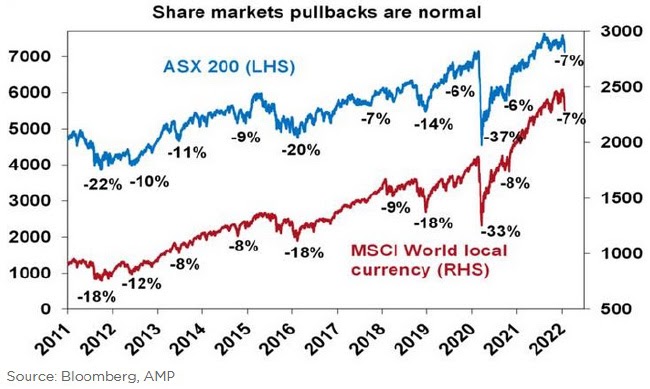
Shares have started 2022 on a dismal note, with many markets around the globe registering a ‘correction’, being declines of between 10% – 20%. 

However, share market pullbacks are normal – and even expected. 

Fluctuations are a natural part of the share market.

While it is not unusual for the share market to move from a record high into correction mode, the media has given a great deal of exposure to the latter, causing unnecessary alarm for some investors.

In the chart above, it can be seen that share markets regularly experience significant sell-offs. The drivers of those pullbacks are diverse and often centre around a combination of rising valuations in the presence of some external risk factor, which could be political, economic, or a “black swan” event (such as a pandemic). 

Since the Global Financial Crisis, markets have successfully navigated the European Debt Crisis, a China slowdown, Fed policy tightening and the worst of Covid-19.

While it is too early to know if the recent correction in shares will lead to a capitulation and a bear market (losses of 20% or more), the upcoming interim reporting season will be of heightened importance.

Investors will focus not only on company operating performance, but also on the outlook comments by management. If expectations are missed, it is likely that some stocks will be heavily marked down. Given that this is often an overreaction, it may turn into a buying opportunity for the patient investor.

Which investor do you want to be?

One of the most important things we can educate our clients on is:

  • to not be distracted by short-termism
  • to avoid exaggerated media noise, and
  • to avoid listening to friends about what they should be doing with their investments in the short term and instead, follow professional advice that aligns with your values and goals.

For the time being, economies are on relatively stable footing, with falling unemployment, rising capital investment, excess savings ready to be deployed and businesses keen to get back to some semblance of normal. 

As usual, we at Hyland Financial Planning will keep a close eye on events as these unfold.

You can have peace of mind knowing our financial planners and investment advisers are consistently monitoring market performance to ensure our clients are always well-positioned to receive optimal investment results. 

If you have any questions or want to talk about investment strategies with one of our financial planners, please reach out. Our door is always open.

Important Things to Know About Retiring Early in Australia

Every person’s dream is to retire early and enjoy the rest of their lives, making the most of their savings. 

This goal can be made more challenging if you don’t have adequate savings or a financial plan. 

Early retirement is an option that seems far-fetched for most people. However, that doesn’t mean that it is entirely impossible to achieve. 

Would you believe me if I said you could retire at 60, 50 or even 45?!

Here in Australia, early retirement isn’t a decision that can be made in a heartbeat. Still, some have already proven that it is possible, so as long as people can make the most of the financial resources available.

If you want to achieve early retirement as well, here are some tips to get you started:

1. Establish a Financial Plan

You do not want to resign from your job without a solid plan in place. Otherwise, you may end up having to search for new income once your savings run out. 

The thing about early retirement is that you must already have a financial plan that will determine all of your expenses and savings before you are ready to finish up in the workplace. This will give you a clear insight into how much your daily expenses will be in retirement and give you a view of how much you need to save in order to have an enjoyable retirement.

Running out of money is never a good thing, and a financial plan may prevent that from happening once you pursue early retirement.

2. Boost Your Superannuation

Your superannuation is essential for a successful early retirement. It will ensure that you have regular income on a weekly, monthly and annual basis.

Now, there are certain stages within your employment wherein you will be given a chance to boost your super; this means that the money paid monthly will increase, increasing your super for retirement.

Feel free to accomplish the boosting of your balance early on so that you will be able to benefit from compound interest over the years.

3. Invest Wisely

One of the best ways to ensure a lifelong source of income is by investing in profitable ventures early on in your career.

While the most viable choice would be a diversified, researched investment portfolio. 

Just be sure to think long and hard about where to put your money; otherwise, you may end up risking your assets in a venture that would not be able to maintain itself, losing you a lot in the long run and making early retirement out of reach.

Start Your Early Retirement Planning with Hyland Financial Planning 

Retiring early is possible if you know the right things to do and make all of the correct decisions before as well as after your career has ended. Establishing a financial plan, boosting your super, and investing in long-term ventures may set you up for a wonderful and relaxing life.

Just remember to follow our tips and never settle for anything less than a great investment that will only grow your assets.

If you are looking for a financial company that deals with early retirement planning in North Shore, Sydney, look no further than our financial advice experts here at Hyland Financial Planning. 

Our financial advisers share an ambition to improve the lives of our clients with strategic planning, wealth creation, and wealth success. 
Contact us today and let us discuss all your financial options

4 Essential Tips When Planning Your Future Aged Care Needs

It’s never too early to start planning your future aged care needs. The earlier you start, the more time you have to prepare to live out your golden years with peace of mind knowing you will be stable and supported. 

Planning for your aged care usually involves organising your legal and financial affairs and establishing what care options you have available within your area of retirement. 

Aged care financial planning involves making future health, housing and legal decisions. 

Some of the most important steps when planning for life in aged care include making sure:

  • You receive the assistance you require if you’re unable to take care of yourself.
  • Your family understands how you want to be cared for in the case of a severe illness or disability. 
  • Your Will specifies what should be done with your estate and assets.

It may be important for you to establish preparations ahead of time to protect your interests if you become extremely ill or wounded and cannot make decisions about your care.

Talking to your family about what you want and need during your later years of life is important. When you have this discussion, it’s beneficial to talk about what aged care services you may need and how that fits within your budget, needs and capabilities.

An aged care financial planner can help you financially plan for your aged care strategy within your budget.

Here are 4 essential things to consider when it comes to planning your future aged care needs:

1. Consider Assessing Your Current Financial Situation

When you’re in retirement and considering aged care options, it’s an excellent idea to organise your finances.

Many aged care options are more expensive than you would expect meaning it’s earlier to start saving or planning for payment solutions earlier rather than later. 

To ensure your finances are on track to meeting your aged care needs and assist you in handling your finances, it may be worthwhile to speak to a personal financial adviser to ensure that everything is in check. This way, managing your finances may become easier, and with that, you can manage the finances required for aged care. 

It’s important to ensure you have a good grasp of the expected aged care expenses and have an effective roadmap in place that can help you navigate the expected expenses as you reach your later years in retirement. 

2. Finalise Your Personal Matters

You might want to put other personal affairs to rest as well. You may choose to visit a particular location with friends, make specific wishes for your funeral or even plan that one last trip to Italy.

Regardless of your preferences, you may want to discuss these desires with your family and friends. From there, you may be able to make them happen if you work together.

3. Appoint Someone to Make Decisions For You

Another approach to plan for your future is to select someone to make choices for you if you become unable to do so yourself. This is also part of the estate planning process that we help our clients with. 

There are many types of legal appointments that confer decision-making authority:

  • Medical Power of Attorney – capable of managing your medical requirements
  • Power of Attorney – can handle your finances
  • Enduring Power of Guardianship – can determine personal, lifestyle and treatment decisions on your behalf should you ever become incapable of making such decisions yourself.

4. Think About What Aged Care Option Suits You

There are various care assistance and housing options available today. 

It’s important for you to know that the choice will solely depend on your preferences, health, age, financial health, and the level of care you may require.  

  • Home Care: This service allows you to remain in your homes and maintain independence, while also assisting you with keeping up with the essential daily home chores.
  • Retirement Villages or Assisted Living Communities: These services provide living arrangements that meet independent and dependent individuals.
  • Aged Care Facilities: If you can’t live independently, or want to take the pressure of yourself,  aged care may be an option worth exploring.

An excellent way to establish what your aged care options are is through the Aged Care Assessment Service (ACAS). You may want to consider booking an aged care assessment as soon as possible, as there could be possible waitlists for certain services or eligibility requirements you may have to meet.

Booking an aged care assessment can also help you decide how much home care you may need in the future and help determine if an income-tested fee would apply to you.

Early preparation and solid advice on advanced aged care planning can help you and your family minimise stress as you age. Speak with a financial adviser for additional information.

Working with a financial planner can provide you with the most up-to-date information regarding aged care in Australia, that is relevant to your financial situation.

Work with a Sydney Aged Care Financial Planning Specialist

If you’re looking for help with your aged care planning in North Shore, Sydney, our team of financial advisers at Hyland Financial Planning (HFP) can help! 

Our service is founded on the desire to improve the lives of our clients with strategic planning, wealth creation and ultimately – wealth success, leaving nothing to chance. 

Please take the next step and secure your financial future by booking a 15-minute call with us today!

How to Set Financial Goals in 2022

Your financial goals, whether they’re short-term or long-term, are considered the backbone of a sound financial plan. Your financial goals should align with your values and objectives in life – as well as your life stage. 

While it’s great to be financially stable, what brings even more joy is being able to live the life you want without having to stress about money. 

Are you looking to set smart, achievable financial goals for the new year?

Here’s what you need to know when setting financial goals.

Three Types of Financial Goals

Short-term Financial Goals

Short-term goals give us a glimpse of where we want to be in the near future. They should be realistic and attached to a timeline. 

Short-term financial goals may include:

  • Setting a budget and sticking to it
  • Paying off small debts like credit cards or 
  • Save an emergency fund
  • Saving a specific amount for a purpose (holiday, new car, renovations etc.)

Mid-term Financial Goals

These goals create a bridge between your short-term and long-term goals. These goals take time, effort and patience to map out. 

Some examples of mid-term financial goals include:

  • Buy a home or investment property
  • Paying off larger debts
  • Secure life insurance cover 
  • Start investing

Long-term Financial Goals

These are the long-game goals you want to achieve – likely before you retire. Long-term goals are designed to help you meet your needs and wants in the future. 

Depending on your financial position, you may achieve some of these early in life. If that is your situation, you can take the time and work with a financial planner to secure and protect your wealth. 

Long-term goals include:

  • Pay off your mortgage
  • Creating a financial plan
  • Save for retirement and perfect your retirement plan
  • Boost your superannuation
  • Secure your investment portfolio

Benefits of Setting Financial Goals

We all want to achieve our dream lifestyle for our future – whether that involves buying a dream home or travelling the world. You’ll need to set financial goals if you want to be financially successful. 

With a clear image of what you want in the future, you’ll be able to take the right steps towards your financial goals. It will also give you a clear picture of what you need and should do to achieve it.

Ready to Set Goals for 2022? 

Work with our financial planners in Sydney or Hornsby 

Hyland Financial Planning has a team of financial advisers in Hornsby that can help you achieve financial success. 

We build personalised financial plans to help individuals, families and retirees achieve all their financial and lifestyle goals. 

We’ll help you determine if you’re on the right path and give recommendations on the next steps to your success. 
Contact us today and take that first step towards your financial goals!